Sküt
Artist
LA
Los Angeles artist Sküt created two robot designs rooted in Pride, visibility, and joyful public art, turning our robots into a moving celebration of love, identity, and connection.
Instagram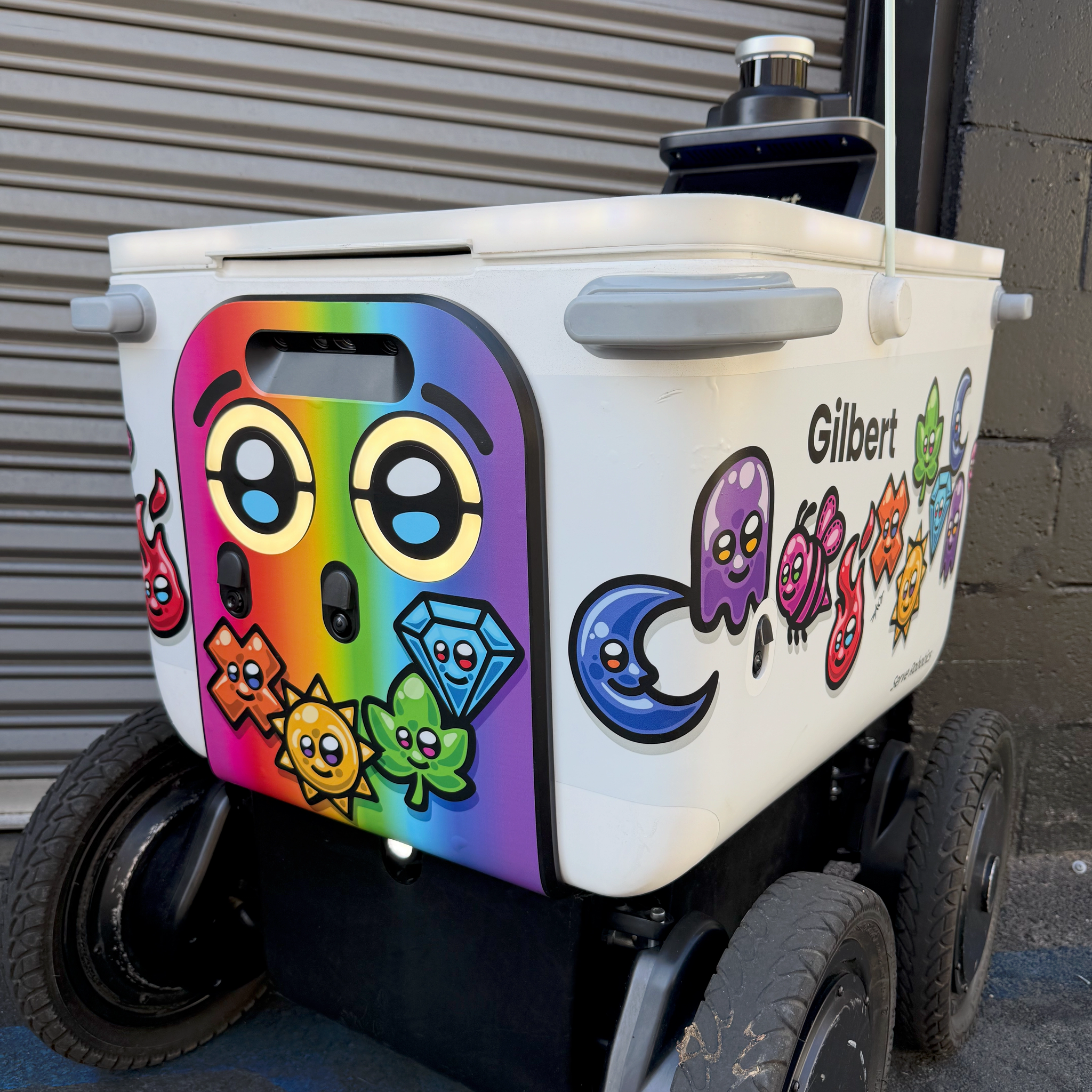
Sküt
Sküt
Artist
Artist bio
Sküt, also known as Scott Lewallen, is a Los Angeles-based multidisciplinary artist, designer, and entrepreneur whose work sits at the intersection of public art, technology, Pride, and community.
Born and raised in Los Angeles, Sküt studied at the University of Southern California’s Annenberg School for Communication and built a career blending graphic design, digital culture, and large-scale creative expression. He is widely known as the original designer and co-founder of Grindr, and his art practice has expanded across murals, sculpture, dimensional wall pieces, immersive installations, projection, light mapping, and bold graphic works.
Sküt’s visual language is bright, solid, nostalgic, and unmistakably optimistic. His work often uses hearts, rainbows, pop references, and layered color to create moments of joy and recognition. In West Hollywood, his Pride-focused public art has become closely tied to themes of LGBTQ+ visibility, Queer history, community, equity, and belonging.
For Moving Canvas, Sküt brings that same spirit to a new public surface: a Serve robot moving through the city.
The design
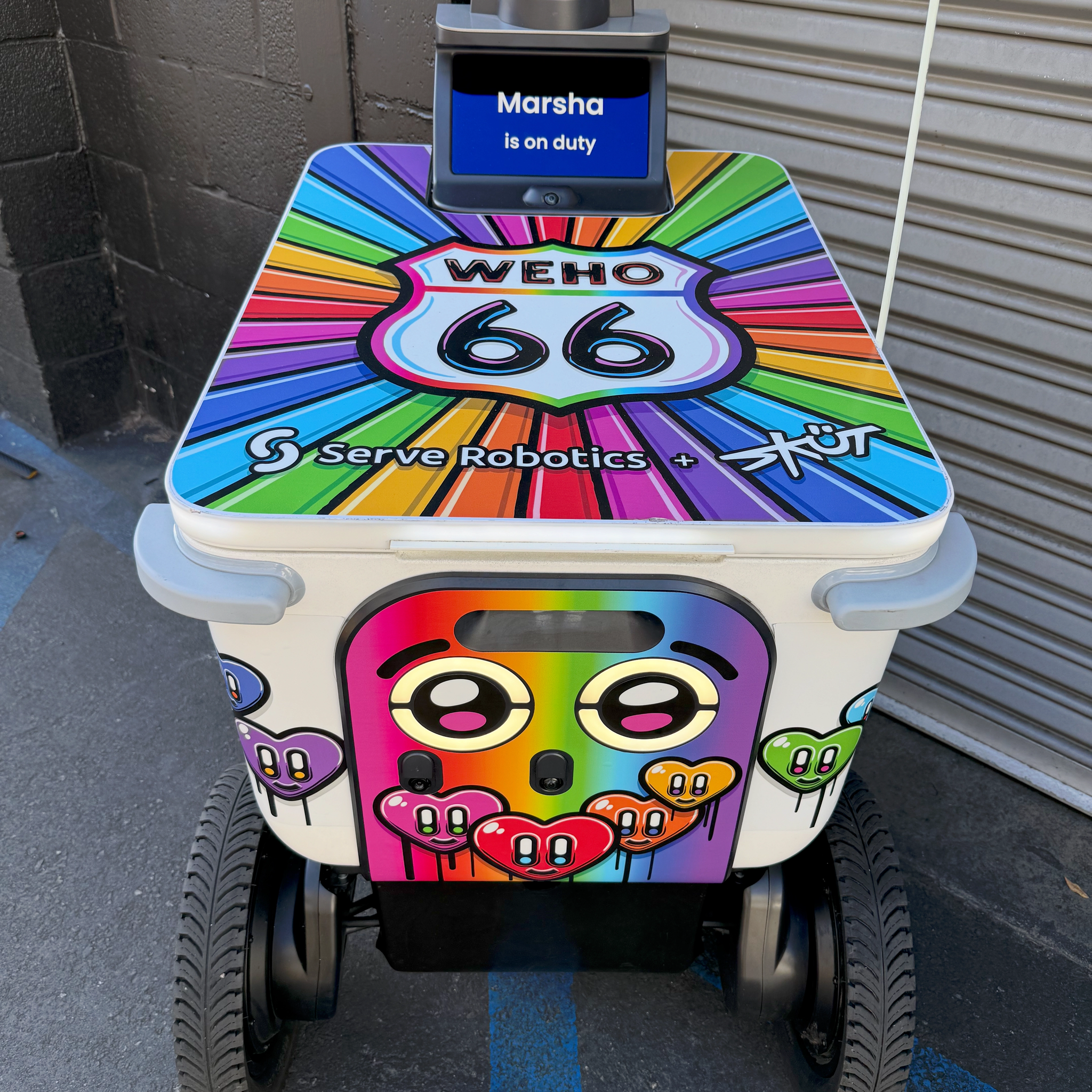
Sküt’s designs transformsour robot into a moving Pride artwork built around color, symbolism, and connection.
The design draws from the legacy of Gilbert Baker’s original Pride flag, where each color carried its own meaning. Sküt reinterprets those colors through original vector iconography, giving each hue an aspirational quality and bringing them together through the shape of a heart.
The result is bright, graphic, joyful, and instantly recognizable. It is designed to stand out on the street, spark conversation, and create a moment of public celebration as the robot moves through the community.
Design inspiration: Pride, Gilbert Baker’s original flag, LGBTQ+ visibility, West Hollywood, public art, original iconography, hearts, color, joy, and community connection.
Design personality: Bold, joyful, proud, loving, and unmistakably visible.
Q&A with Sküt
- What inspired your designs? My work pulls inspiration from pop culture, street art, symbols, and illustration techniques. As a graphic designer obsessed with branding, I’m always chasing iconic, instantly recognizable visuals.
The designs for Marsha and Gilbert are really an anthology of ideas I’ve been developing and refining over the years. The 2026 refresh brings those elements together into a cohesive family. Both robots share a common design language: vibrant 360 wraps, playful hearts and icons, a Route 66-inspired hood graphic, rainbow color bursts on the front and back, and anime-inspired eyes that help bring their personalities to life. - What excites you most about bringing your designs to the community by way of Serve? The most rewarding part is witnessing interactions with the robots IRL. I love watching people see them and start asking questions about how art and technology relate to their daily lives.
What makes it even more special is when people discover that Marsha and Gilbert aren’t just names. They’re physical homage to important figures in LGBTQ+ history, and suddenly the robot becomes a conversation starter and storyteller for the community. - How do you see the robot fitting into the community visually? I see the robots as neighborhood characters living locally, rather than simply machines delivering food.
There’s something wonderfully fantastical about them. Each one develops its own personality, like quirky NPCs in a Zelda game, and people naturally begin to recognize them, interact with them, snap pics, and even become attached to them. In the same way people anthropomorphize their pets, I want people to do the same with these cute delivery robots. - Are you aiming for the robot to blend in, stand out, or spark conversation? Definitely spark conversation.
That magic moment when people start wondering what the robots are doing, why they look a certain way, why the names Marsha and Gilbert, or do symbols have significance, etc. That’s when the design wins.
Marsha has been rolling through West Hollywood since 2023, and it’s been fun watching people recognize her, notice how she’s evolved over time, and share photos of her on social media. Gilbert is a newcomer, and people seem to enjoy his colorful parade of icons.
I think my designs succeed when someone shares a moment with one of the robots. - Did you draw on any local culture, landmarks, or traditions in your design? All of the above. Both designs are a collage of culture, location, and tradition.
Marsha is named after Marsha P. Johnson, the activist and pivotal figure associated with the 1969 Stonewall uprising in New York City. Gilbert honors Gilbert Baker, the artist who designed the original rainbow Pride flag in 1978 at the request of Harvey Milk.
Both robots also share a stylized Route 66 emblem on the hood. Route 66 runs along Santa Monica Boulevard through the heart of West Hollywood, and as the route celebrates its centennial in 2026, it felt like a fitting tribute to an iconic piece of local and national history.
We learn from the past, and artistic expression is a wonderful way to educate through these robot ambassadors to the future. - How do you want people to feel when they encounter the robot?
More than anything, I want people to feel curious.
Curiosity is what led me to reach out to Serve Robotics in the first place. I was curious about what the robots were doing in West Hollywood and wondered if it was possible to decorate them in a meaningful way that speaks to our community.
The hearts, icons, colors, and characters are all little breadcrumbs inviting people to ask questions. Why are there eight hearts? What do the symbols represent? Are the colors significant? What do their names mean, Marsha and Gilbert?
Curiosity opens a door to deeper stories, and I hope my designs reward people who take the time to explore. - What story or message does your design tell about the community? At its heart, the message is about love, acceptance, and belonging.
People can find community and family in unexpected places, and I hope Marsha and Gilbert can serve as small beacons of joy and affirmation. Hidden beneath the hood on both robots is a character I created holding a bouquet of rainbow balloons orbiting a larger heart inscribed with graffiti-style text, “You Are Not Alone.” Next to it is another simple message: “Delivered with Love.”
Those little details are meant to be discovered and hopefully bring a moment of surprise, comfort, or connection to anyone who sees them. - How would you describe the personality your design gives the robot? After four years designing Marsha and two years designing Gilbert, they’ve developed distinct personalities in my mind.
Marsha is the rebel of the pair. She’s bold, independent, and a trailblazer. Her design revolves around expressive hearts that feel joyful, a little edgy, and occasionally even a touch melancholy.
Gilbert is the chill artist. His design is built around a collection of custom icons inspired by the meanings behind the original eight-color Pride flag designed by Gilbert Baker. Each color represents a specific frequency of the queer experience: Sex, Life, Healing, Sunlight, Nature, Magic, Serenity, and Spirit.
They share the same visual DNA, including the Route 66 hood graphic, expressive eyes, and vibrant side wraps, but each bot has its own unique personality and story to tell.