
Keeping the ‘Startup Edge’

Keeping the ‘Startup Edge’
Article
From Entropy to Execution: Staying a Startup at Scale
by Ali Kashani, Co-founder CEO
A few weeks ago, I shared an excerpt from the CIA’s secret sabotage manual on our company’s Slack. This manual was written in 1944, and even today it’s a rich source of techniques for bringing any organization to its knees. Among its tips: Make “speeches” and hold conferences, refer back to matters decided upon, insist on perfect for the unimportant work, multiply procedures, haggle over precise wordings, insist on doing everything through channels, refer all matters to committees and advocate “caution” everywhere. My message: The world’s premier spy agency uses these techniques to undermine its enemies. Try not to use them here.
The post led to an interesting discussion. After all, we are a public company. Some committees and channels are required by law! But as I like to remind the team, we are not just a public company: We are a public startup.
That means we are still in discovery. We value execution speed and learning over precision in planning. While building our public-company muscles for transparency, robust controls, and predictable delivery, we must preserve a startup’s high ambitions and the appetite for risk-taking.
The CIA manual presents anti-patterns that are detrimental to any organization, but they’re especially crippling for a startup. While we have to put in place necessary guardrails, we can’t let guardrails become roadblocks or lead us into premature maturity.
Startups reduce entropy
Startups are, by definition, operating in high-entropy environments: Untested markets, new technologies, new products. They need agility to deal with the inevitable chaos, which they must turn into knowledge and orderly productivity.
Startups reduce entropy for a living. They convert uncertainty into information, unknown unknowns into knowledge. At scale, the startup economy may be the most powerful entropy-reduction engine ever created!
It’s often startups that invent and commercialize new technologies, create brand-new product categories, or discover new markets. They rush into the realm of entropy where they find wedges to displace what exists today.
This earns them the right to continue to exist beyond the startup stage.
Mature companies reduce risk
As a startup matures, its focus shifts from dealing with uncertainty to managing risk. This is a fundamental change in the primary function of the organization. The company faces less entropy because it now operates in the tamer, more orderly markets that it created. It will face fewer unknown unknowns and its focus will shift to managing the known unknowns (i.e., risk).
Uncertainty and risk are often used to mean the same thing, but they describe different concepts. Risk is about known unknowns: we can list possible outcomes and assign probabilities to them (even roughly). Uncertainty is about unknown unknowns: we can’t list or assign probabilities to them, because we can’t even imagine them yet. What’s so unique and special about startups is that they are apt at dealing with completely unpredictable things that come out of nowhere to disrupt their operation.
Risk management leads to stasis
With more to lose, big organizations become risk management engines, creating more and more processes to reduce variability and ensure the outcomes they and their shareholders expect. Those same processes often bog down innovation and make it hard to jump on new opportunities. When you have something to protect, it is natural to become more cautious. And that can lead to stasis.
We can see this all around us. In its first years, Airbnb was all about proving that its disruptive home-sharing concept would be accepted by society. Today, Airbnb is all about overseeing typical marketplace problems, managing policymakers, and battling bad actors and abuse. At best, Airbnb’s product innovation in recent years has been incremental.
Or look at Google. The inventors of transformers (i.e., the T in ChatGPT) were surprised by OpenAI’s meteoric ascent. It took Google years to reorganize itself and put forward a credible response. This is because Google was so preoccupied with risk management that it had stopped shipping ground-breaking product innovations, even if its research team were able to produce the novel technologies needed for such products. Case in point: When copying OpenAI, Google failed miserably at first, making inferior, overly-guardrailed models that were widely ridiculed.
Or consider how BlackBerry lost to the iPhone despite its history of innovation and market dominance. The examples are endless.
Preserve an appetite for entropy
I find thinking about startups as entropy reduction engines very valuable. The only way to fight what has historically been an inevitable stasis is to understand what it is that we have to fight.
A startup’s advantages are its urgency, intensity, and appetite for uncertainty. If it succeeds, this entropy reduction is often incredibly valuable—to itself, and to society.
Four years after spinning Serve out of Uber into a standalone company, we orchestrated what is likely the fastest pace of autonomous fleet expansion to date, going from 100 deployed robots to more than 2,000, from a single market to 20 cities across six major markets covering a population of 3 million people and serving thousands of restaurants. Within 12 months, we had created one of the largest autonomous urban robot fleets.

All of this was made possible by our desire to face unknown unknowns every day as we grew.
As we continue to grow, as a startup and as a public company, I worry about the danger that bureaucracy dulls our edge. We need to preserve our intensity while pairing it with the rigor and predictability that our increased scale and maturity demand.
As the CIA astutely observed, insisting on committees, channels, procedures, and paperwork can take away from rapid, iterative experimentation and learning, which is what we need to continue reducing entropy.
Three ways we avoid stasis
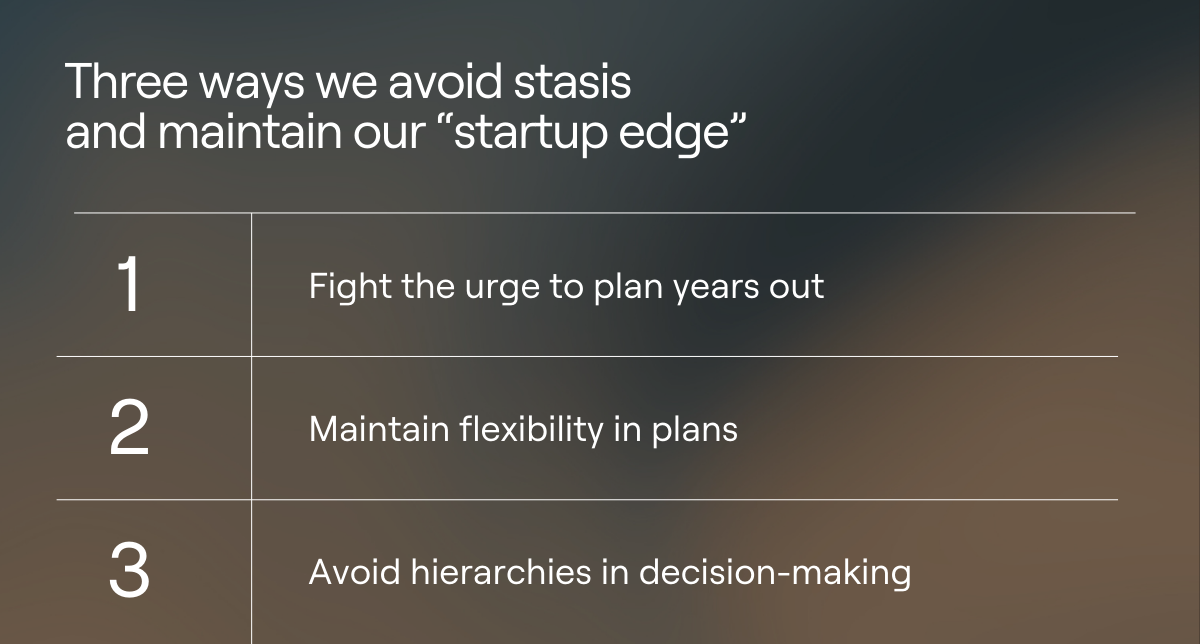
So how do we avoid premature maturity and maintain our “startup edge”? Here are three ideas:
- 01Fight the urge to plan years out. There are some teams, like facilities or hardware development, that naturally have very long timelines and would like to know what we’ll be doing in 2030. We try to limit the number of brain cycles we devote to such long, unpredictable time horizons. Given the significant uncertainties we are dealing with, it is extremely difficult to predict accurately and make plans that prove valuable multiple years out. On the other hand, changing plans too often feels unstable and unsettling. So to preserve agility, we focus planning on near- to medium-term time horizons instead.
- 02Maintain flexibility in plans. When we plan for 6, 12, or 18 months out, we refer to them as "plans of record" to signal that they can change. People like to spend a lot of time making detailed plans, and then they become too rigidly attached to them. The time invested in planning itself creates a sunk-cost fallacy: Changing a plan we invested so much time in would feel like a failure, and the idea of investing even more time to come up with a new plan would feel daunting.
We try to keep these plans at the right level of detail. We make sure to maximize our time spent executing, versus making overly precise plans that will likely fall apart once the game begins. After all, as Mike Tyson said, “everybody has a plan until they get punched in the mouth.” We always remind folks that plans are subject to change when new information arrives. - 03Avoid hierarchies in decision-making. At Serve, people across the org chart can talk directly to one another and don't need to follow structures or hierarchies. This is essential for preserving the rapid flow of information to enable agile decision making and the updating of plans as new learnings come in.
Maturing is inevitable, and risk management is increasingly important as a company grows. Our objective is to not ignore risk, but also to avoid rushing into stasis. We set our sights on finding the right balance between uncertainty and risk management, so that we retain the energy, focus, and drive required to reduce entropy every day.
This essay was originally published on Substack. You can read and subscribe here.